“Why Did This Happen to Us?”
A conversation in Cambodia made me think about how different societies explain tragedy.

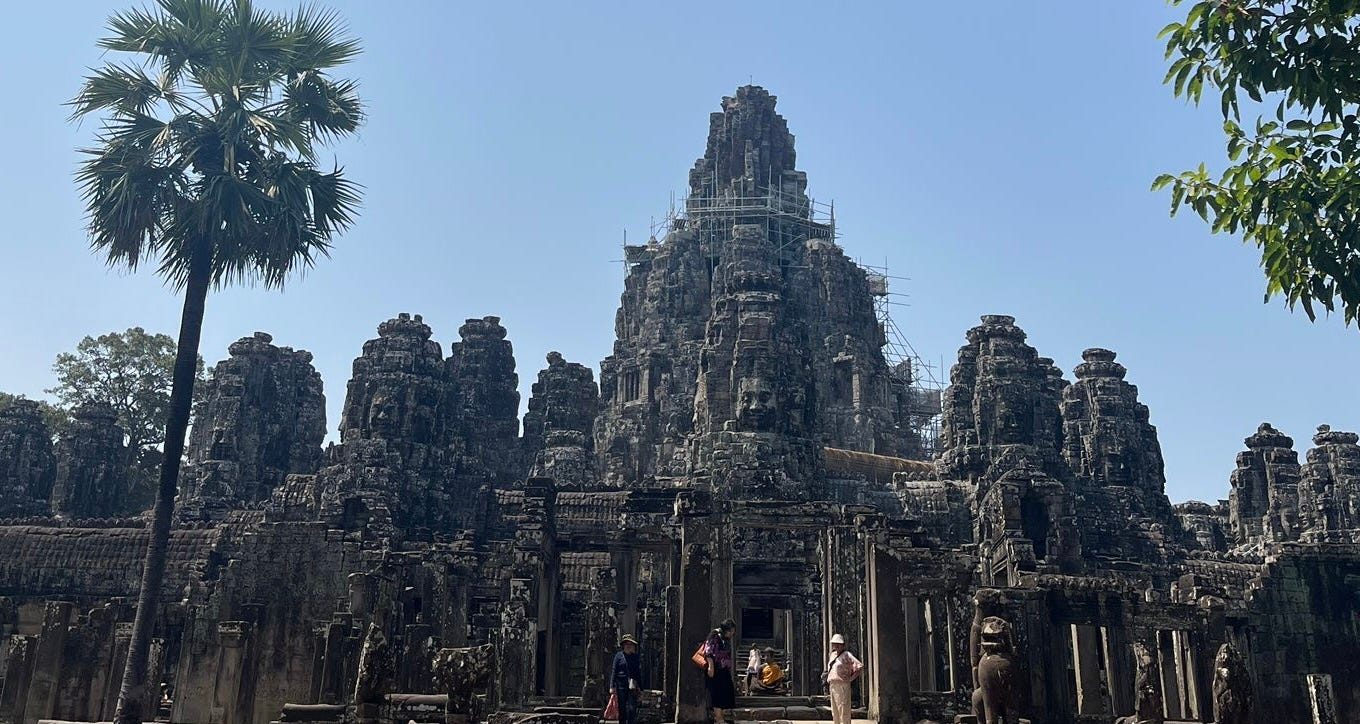
Walking between a temple and a pyramid, I started talking to our tour guide. I was asking questions about Cambodia’s recent history.
He started talking about the Vietnamese, alleging they were responsible for the Cambodian genocide. His tone shifted. The whole day he had been making jokes and being silly, but he seemed reflective and angry. He went into more detail before saying,
“Why did this happen to us?”
It wasn’t a rhetorical question. He genuinely seemed to want an answer.
The question rang with me, and later, a Cambodian father I met by the hotel pool also asked the same question. This time, it was not me who brought up the history, his daughter asked if I knew who Pol Pot was.
Growing up in a non-religious Jewish family, the Holocaust was something often spoken about.
When I was being told about what had happened, the genocide was framed as something that was inevitable. Antisemitism had lasted centuries, building up until it reached its natural peak: the Holocaust.
Cambodia’s national story is different. Once a great civilisation that controlled much of what is now Southeast Asia, it is today a country roughly half the size of Germany, after centuries of Thai, Vietnamese, and French domination.
For a civilisation that once built one of the largest pre-industrial cities in the world, Angkor, the contrast with modern Cambodia is striking.
Driving past houses made from cheap materials and wells pumping water from the ground, the contrast with Angkor’s vast reservoirs and hydraulic systems is striking.
If it weren’t for French colonisation, there is a good chance Cambodia would have been swallowed up by Thailand and Vietnam.
After independence from France in 1953, Cambodia’s monarchy was eventually overthrown in a coup. A few years later, Pol Pot and the Khmer Rouge seized power, introducing an extreme revolutionary regime that killed roughly a quarter of the population, around 1.7 million people.
Communism initially struggled to gain traction in Cambodia, gaining support only after years of political instability.
Many Cambodians believe that the Viet Minh constantly tried to influence Cambodian politics towards the left, until eventually they supported Pol Pot.
In reality, Vietnam and the Khmer Rouge became bitter enemies, with the Khmer Rouge massacring Vietnamese citizens living in Cambodia. Pol Pot was originally a nationalist but radicalised toward his extreme anti-imperialist, agrarian strain of communism in a French university.
Vietnam eventually overthrew the Khmer Rouge and occupied Cambodia for ten years. While this ended the genocide, it left many Cambodians uneasy with the global narrative that Vietnam “saved” the country, especially given the long rivalry between the two countries and Vietnam’s continued influence in Cambodian politics.
The fact that their saviours were communists who presented themselves as anti-imperialist, but then occupied them for ten years, must be hard for Cambodians.
There is a clear difference between the genocides. In Cambodia, the genocide was mainly committed by Cambodians under duress or who feared speaking out against the regime. It has created a mixture of guilt and victimhood.
The Jewish narrative portrays Jews as victims and Germans and their allies as the perpetrators, making it easier for us to talk about what happened.
Among Jews, there is little doubt the Holocaust happened or questioning why it did. It was extensively documented, and the reasons it happened were clear. Radical left- and far right-wing attempts to deny it are fringe, though increasing.
Paradoxically, the existence of Holocaust denial may be what compels Jews to fight it by educating people about what happened.
Cambodians rarely deny that the genocide happened, although many remain unsure why it happened. There are also similarities between the Cambodian and Jewish experiences.
Many Nazis retained positions of power in post-war West Germany, just as former Khmer Rouge officials still hold influence in Cambodia today.
Just as I recognise resilience in my own ancestors who survived the Nazis, I see it in the Cambodian people, who are noticeably friendlier and happier than those in other Southeast Asian countries I have been to.
The temples are a source of national pride. Angkor Wat, the largest temple in the old city, sits on the Cambodian flag itself. Walking around the temple was an experience, seeing what the Cambodian people were once capable of. It is sad that a civilisation capable of such achievements faced such political and economic setbacks, with massive parts of their historical land inside Thai and Vietnamese borders.
Now they are going through a long recovery after that catastrophe. The Jewish people have never had a golden age and have been a diaspora people for around 2,000 years.
Today, many people believe Jews are thriving globally. Jews are tolerated in most countries and now have Israel, a form of insurance against future waves of hatred.
Cambodia is a brilliant country, and it feels like it is increasing in prestige and in living standards.
It is interesting to see how different cultures explore their trauma and the stories they tell themselves.
Cambodia looks to the past, at how much better things were before, whereas Jews, after being given their ancestral homeland, are now on the up.
Perhaps the real difference is not the tragedy itself, but how societies choose to explain it to themselves.
Why do some societies explain tragedy with certainty, while others are still asking why?
Thanks for reading. If you enjoyed this essay, consider subscribing. I publish new essays every Tuesday, Friday and Sunday on current affairs, culture, masculinity and politics.